
STORY
Generative art, for me, is the practice of designing systems rather than composing individual images. Every collection begins with a question: What visual language can emerge when geometry, color, and computation are allowed to interact under a carefully designed set of rules? Rather than drawing a finished composition, I write algorithms that define how forms evolve, intersect, repeat, balance, and transform. Each generated work becomes a unique expression of the same underlying system. My practice is rooted in architecture, mathematical structure, spatial relationships, and modern abstraction. I am drawn to the idea that simple geometric elements—lines, planes, grids, vectors, and modular forms—can produce unexpected complexity through deterministic rules and controlled randomness. The computer is not used as a tool to automate image-making; it is a creative collaborator operating within boundaries that I design. Across my collections, I investigate different aspects of computational composition while maintaining a consistent artistic philosophy. Chapel Cities explores imagined architectural landscapes where monumental geometric forms suggest cities that exist between...
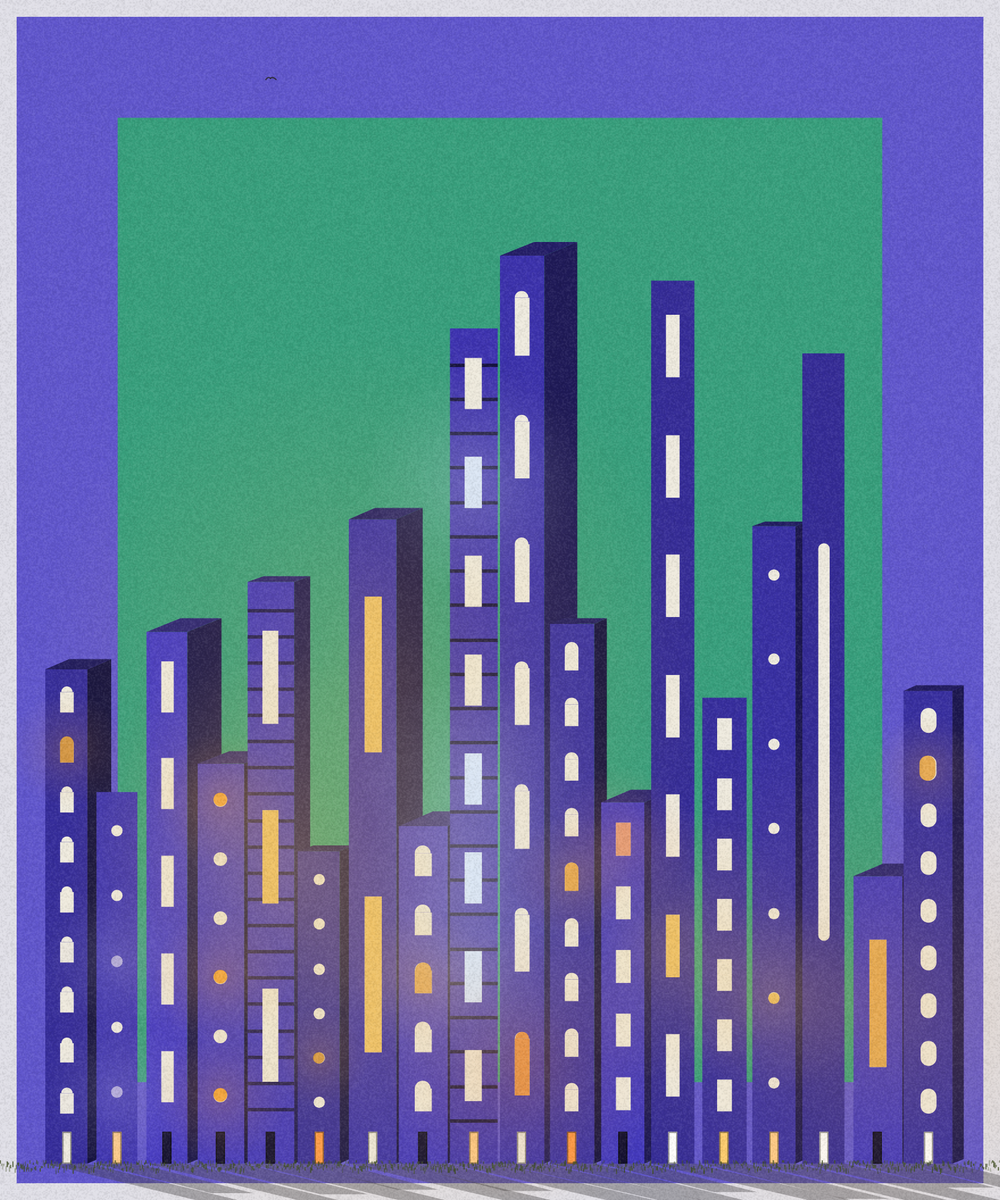
Generative art, for me, is the practice of designing systems rather than composing individual images. Every collection begins with a question: What visual language can emerge when geometry, color, and computation are allowed to interact under a carefully designed set of rules? Rather than drawing a finished composition, I write algorithms that define how forms evolve, intersect, repeat, balance, and transform. Each generated work becomes a unique expression of the same underlying system. My practice is rooted in architecture, mathematical structure, spatial relationships, and modern abstraction. I am drawn to the idea that simple geometric elements—lines, planes, grids, vectors, and modular forms—can produce unexpected complexity through deterministic rules and controlled randomness. The computer is not used as a tool to automate image-making; it is a creative collaborator operating within boundaries that I design. Across my collections, I investigate different aspects of computational composition while maintaining a consistent artistic philosophy. Chapel Cities explores imagined architectural landscapes where monumental geometric forms suggest cities that exist between memory and abstraction. VESYRA establishes my broader visual language through algorithmic geometry, compositional balance, and color relationships, forming the foundation of my generative practice. Interstice examines the spaces between forms, treating negative space as an active structural element rather than empty background. Civic Loom imagines urban environments as woven systems, where modular structures and rhythmic bands become metaphors for infrastructure, movement, and human connection. Lattice investigates interconnected frameworks, grid logic, and structural repetition, revealing complexity through modular organization. Switchfield explores transformation through shifting geometric states, where compositional changes emerge from algorithmic decisions and spatial transitions. Constellations studies distributed relationships between independent elements, creating visual networks that echo celestial patterns while remaining grounded in computational structure. Vector Field focuses on directional movement and procedural flow, using algorithmically generated vectors to create dynamic compositions shaped by invisible forces. Although each project has its own identity, they are united by a common interest in how rule-based systems can generate forms that feel intentional, balanced, and alive. My work is less concerned with depicting recognizable subjects than with constructing visual environments that invite contemplation through rhythm, proportion, and emergence. As both artist and developer, I build my own generative systems from the ground up, carefully refining compositional logic, geometric constraints, palette behavior, and variation. Every output is generated from original code, ensuring that no two works are identical while preserving the conceptual integrity of each collection.